monographs + edited volumes
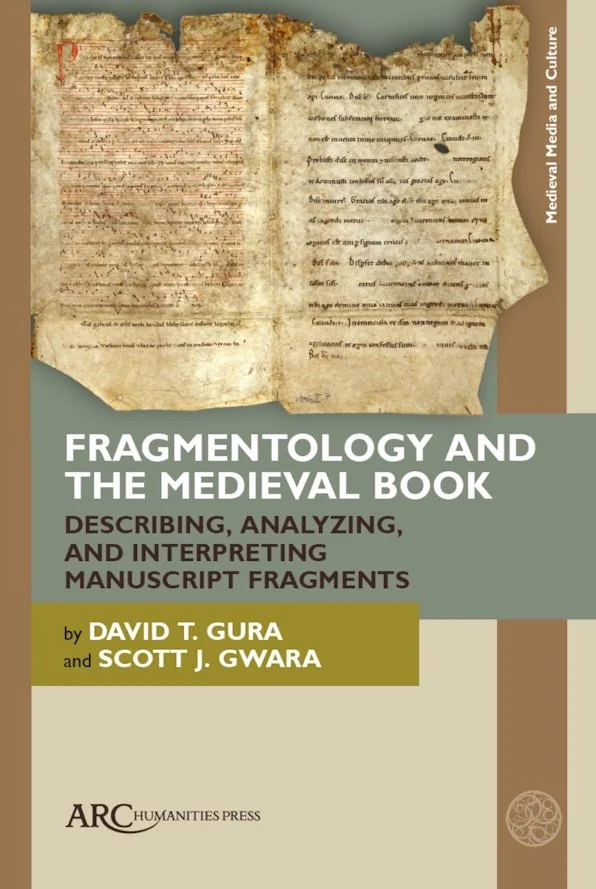
Fragmentology and the Medieval Book: Describing, Analyzing, and Interpreting Manuscript Fragments – David T. Gura and Scott J. Gwara. Medieval Media and Culture. ARC Humanities Press, 2026.
398 pp • 6..00 x 9.00 in • ISBN 9781802702828 • Hardcover • $215
[From ARC website:] Aimed at students, educators, librarians, and collectors, this volume explores the discipline of Fragmentology—the study of medieval manuscript fragments ranging from the smallest initials to substantial remnants. Like the medieval books they come from, fragments are unique cultural artifacts offering opportunities for innovative teaching and research. The introduction conveys the history of manuscript fragmentation and its motivations: obsolescence, scholarship, and commerce. Individual chapters focus on fragment theory and the practical skills required to study fragments: forensic description, textual identification, provenance research, and palaeographical and codicological analyses. Digital tools are presented as complementary means to traditional approaches. Through case studies, the authors focus on the medieval genres most commonly encountered, such as bibles, books of hours, and liturgical books.

A Descriptive Catalogue of the Medieval and Renaissance Manuscripts of the University of Notre Dame and Saint Mary's College – David T. Gura. Notre Dame: University of Notre Dame Press, 2016.
xxxiv +716 pp. + 8 color plates • 7.00 x 10.00 • ISBN 978-0-268-10060-5 • Cloth • $150
[From UND Press website:] David T. Gura’s innovative catalogue describes the 288 medieval and Renaissance manuscripts held by the University of Notre Dame (Hesburgh Library and Snite Museum of Art) and Saint Mary’s College. Bound manuscripts, leaves, and fragments, which span the late eleventh through the sixteenth century and include bibles, books of hours, calendars, liturgical texts, and much more, are given thorough critical treatment and scholarly description. Organized by repository, each manuscript description is based on Gura's intensive paleographical and codicological analyses, which address features such as material and support, collation, illumination, layout, script types, ownership history, book bindings, and bibliographical references. Scaled diagrams of distinct and variant ruling patterns and border arrangements are included with each catalogue entry to facilitate comparison with each other and with manuscripts outside the collection. Gura’s flexible schematic for analytical manuscript description presents the important aspects of particular genres of the manuscripts, distinguishes their uncommon features, and interprets them. In his introduction to the catalogue, Gura provides a history of the formation of the manuscript collections, a scholarly overview organized by genre, and a detailed explanation of his analytical schematic. Paratextual materials allow readers to browse all manuscripts in the collections by repository, date, country or region of origin, language, and textual contents. Academic librarians, manuscript dealers and collectors, and the community of scholars, curators, and librarians who work with medieval and Renaissance manuscripts will find this an accessible and valuable resource.
Reviews: Scriptorium, Bulletin Codicologique 2017.2, 177-8; The Medieval Review 18.03.16; Parergon 35 (2018): 219-20; Medievalia et Humanistica 44 (2018): 119-21; Speculum 94 (2019): 837-9.

Between the Text and the Page: Essays in Honor of Frank T. Coulson – eds. Harald Anderson and David T. Gura. Toronto: Pontifical Institute of Mediaeval Studies, 2020
Papers in Mediaeval Studies 33 • vi +370 pp. • ISBN 978-0-88844-833-0 • Cloth • $95
[From PIMS website:] This volume pays homage to manuscripts and early printed books as material witnesses in the Middle Ages. The essays discuss broad questions relating to the partisan interpretation of texts, but they also illustrate how small details of format, script, and decoration uncover the text, its context, and its reception.
Some articles explore scientific methods, examining whether social network analysis can offer an advance over traditional methods of establishing textual connections and using statistics to understand the transmission of ancillary materials. Others present critical editions and contextualize lost genres, providing a first edition of an unedited summary of Ovid’s Metamorphoses steeped in the Boccaccian genealogical tradition, exploring mock funeral eulogies for animals, and discussing the variety of texts that pay witness to Ovid’s penetration into vernacular literature. A closing brace of essays catalogue collections and reflect on changing trends in the study of manuscripts.
Contents
Introduction • 1
Virgil and the Censors: Printing Across the Confessional Divide • CRAIG KALLENDORF • 3
Textual Networking in the Verse Liber Exameron from Manuscript Barlow 21 • GRETI DINKOVA-BRUUN • 28
The Earliest Fragments of a Latin Declamatory Corpus: The Quintilianic Minor Declamations and the Excerpta of the Elder Seneca • BART HUELSENBECK • 40
Signa, Res, et Memoria: Ordering the Virtues of Saints in Boulogne, Bibliothèque municipale, Ms. 107 • DAVID DEFRIES • 66
The Scribal Verses of Waltherius in a Twelfth-Century Manuscript of Josephus • ROBERT G. BABCOCK • 87
The Raven and the Crow: An Ovidian Hermeneutical Node • ROBIN WAHLSTEN BÖCKERMAN • 108
On the Frequency of Ancilia in Medieval Manuscripts • HARALD ANDERSON • 132
Tibullus in the Roman Academy • JULIA HAIG GAISSER • 146
A Prose Summary of Ovid’s Metamorphoses from Fourteenth-Century Italy: Vatican City, Biblioteca Apostolica Vaticana, Ross. 228 • DAVID T. GURA • 165
The Owl and the Pussycat: Following the Trail of a Neo-Latin Mock Funeral Oration • QUINN GRIFFIN • 208
Manuscript War Stories Aren’t What They Used to Be • MARJORIE CURRY WOODS • 225
Dirc Potter, the “Dutch Ovid” and His Der minnen loep (The Course of Love) • WILKEN ENGELBRECHT • 229
Je me souviens: The Forgotten Collection of Medieval and Renaissance Manuscripts Owned by Gerald E. Hart of Montreal • SCOTT GWARA • 255
Medieval Manuscripts at the University of Virginia • GREGORY HAYS • 289
Bibliography of Frank T. Coulson • WENDY WATKINS • 349
Rufi Arnulfi Aurelianensis Commentum super Ovidii Metamorphoses (approved by CC CM editorial board, June 2018). manuscript.
A critical edition of Arnulf of Orléans' accessus, grammatical glosses, and allegories to Ovid's Metamorphoses composed c. 1175. The edition takes into account over 60 manuscripts of the commentary, discerns their textual relationships, and critically edits the text with apparatus criticus and apparatus fontium. Portions are based on my 2010 doctoral dissertation, "A critical edition and study of Arnulf of Orléans' philological commentary to Ovid's Metamorphoses," (Ohio State) which deciphered the manuscript tradition of the accessus and glosulae, and critically edited the accessus nd glosses to books 3, 7, 8, and 11. The current project presents the full commentaries (grammatical and allegorical) in their late 12th and early 13th-century manuscript context, in which each portion alternates per book of the Metamorphoses. Arnulf's commentary proved to be among the most influential, circulating for three centuries in a variety of formats and informing the humanist reception of the text among figures like Zomino da Pistoia and Damiano da Pola.
articles + chapters
“Ovid at St Augustine’s Abbey, Canterbury: The Metamorphoses Paraphrase of John of London,” in “Of latine and of othire lare”: Essays in Honour of David R. Carlson, eds. Richard Firth Green and R.F. Yeager, 45-66. Pontifical Institute of Medieval Studies, 2022.
“The Medieval Provenance of Otto Ege’s ‘Chain of Psalms’ (FOL 4),” Fragmentology 4 (2021): 95-9. DOI: 10.24446/7blr
“New Manuscript Evidence for Adenet le Roi’s Berte as grans piès,” Medium Aevum 89.1 (2020): 50-77.
“A Prose Summary of Ovid’s Metamorphoses from Fourteenth-Century Italy: Vatican City, Biblioteca Apostolica Vaticana, Ross. 228,” in Between the Text and the Page: Essays in Honour of Frank T. Coulson, eds. H. Anderson and D.T. Gura, 165-207. Pontifical Institute of Mediaeval Studies, 2020.
"A Ninth-Century Fragment of Basil of Caesarea's De Spiritu sancto and a Lost Majuscule Codex,” Byzantion 89 (2019): 243-74.
"The Ovidian Allegorical Schoolbook: Arnulf of Orléans and John of Garland Take Over a Thirteenth-Century Manuscript," Pecia 20 (2017, publ. 2018): 7-42.
"Living with Ovid: The Founding of Arnulf of Orléans’ Thebes,” in Manuscripts of the Latin Classics 800-1200, ed. E. Kwakkel, 131-66. Leiden University Press, 2015. [Reviews: Speculum 91 (2016): 517-8; Quaerendo 46 (2016): 83-99; Manuscript Studies 1 (2016): 353-6]
“A Hitherto Unknown Book of Hours from the Amiénois: Notre Dame, Saint Mary’s College, Cushwa-Leighton Library, MS 3: or the Le Féron-Grisel Hours,” Manuscripta 56 (2012): 227-68.
“From the Orléanais to Pistoia: The Survival of the Catena Commentary,” Manuscripta 54 (2010): 171-88.
co-authored
K. V. Manukyan, B .J. Guerin, E. J. Stech, A. Aprahamian, M. Wiescher, D. T. Gura, Z. D. Schultz, “Multiscale X-ray Fluorescence Mapping Complemented by Raman Spectroscopy for Pigment Analysis of a 15th-century Breton Manuscript,” Analytical Methods 8 (2016): 7696-7701.
under contract
“Testamentum porcelli” in ed. J. A. Stover, The Oxford Guide to the Transmission of the Latin Classics. Oxford University Press. [completed]
“Notitia urbis Romae,” in ed. J. A. Stover, The Oxford Guide to the Transmission of the Latin Classics. Oxford University Press. [completed]
book reviews
Review of Peter Kidd, A Descriptive Catalogue of the Medieval Manuscripts of the Queen’s College, Oxford (Oxford: Oxford Bibliographical Society, 2016), Speculum 95 (2020): 269-70.
Christian Meyer with Barbara Haggh-Huglo and Shin Nishimagi, Catalogue des manuscrits notés du Moyen Âge conservés dans les Bibliothèques publiques de France: Collections du Nord-Pas-de-Calais et de Picardie: Abbeville, Amiens, Arras, Bergues, Boulogne-sur-mer, Cambrai 4.1 (Turnhout: Brepols, 2014) in Speculum 91 (2016): 529-30.
Rodney M. Thomson, Catalogue of Medieval Manuscripts of Latin Commentaries on Aristotle in British Libraries Volume II: Cambridge (Turnhout: Brepols, 2013) in Manuscripta 58 (2014): 304-8.